
Ever wonder why it’s so much easier to cut a tough material like rubber or leather with a sharp knife than it is to rip or tear it with your hands? Researchers from SoftComp partner ESPCI, CNRS and Sorbonne University, France have dived down to the molecular level to finally answer this long-standing question in materials science. They found that the key difference lies in how much the material stretches and deforms right at the tip of the crack or cut.

New Doctoral Network: Edible Soft Matter (ESM)
9 December 2025
Capillary Waves Found Between Fully Miscible Fluids
15 December 2025New Doctoral Network: Edible Soft Matter (ESM)
9 December 2025Capillary Waves Found Between Fully Miscible Fluids
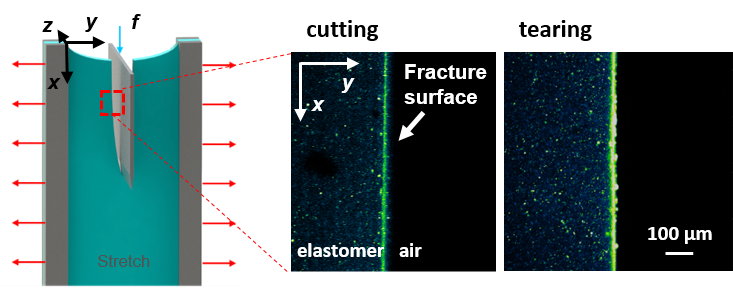
15 December 2025The Key Finding: A Sharp Blade Stops Stretching (Fig.1)
Tearing (Pure Fracture): When you tear a soft material, the crack tip blunts (widens and deforms greatly). This extensive stretching requires a lot of energy, causing a large number of polymer chains to break over a wide area, which is why tearing is so difficult.
Cutting (Sharp Blade): A sharp blade acts as a strain localizer. It suppresses this blunting at the crack tip. By limiting the stretching, the blade reduces the volume of material that needs to be broken. This dramatically lowers the required energy and the amount of molecular damage.

Fluorecent Molecules reveal the Mechanism (Fig.2)
To see this process happen at the molecular level, the scientists used mechanochemistry—a technique that involves labelling the polymer chains with special fluorescent molecules (called mechanophores). When the chains break during cutting or tearing, these labels light up, allowing them to directly quantify the broken bonds.
The findings show a clear relationship: less blunting leads to less molecular damage, which results in less energy required for the cut.
Novel Polymer Networks within Reach
This knowledge makes it possible to design polymer networks that can control their shear and tear strength independently of each other. This is an essential basis for the development stronger protective materials, better biomedical devices, and more efficient recycling processes.
Read more: Zhao et al. Nat. Commun. 16, 3203 (2025)
SoftComp partners: ESPCI